
The Roots of Reggae

Echoes Of Eras: The Roots of Reggae - History, Icons, and Vibe

One Love, One Heart, One Rhythm

The Jamaican Beat: Where Did Reggae Come From?

Reggae is a music genre that started in Jamaica in the late 1960s. It quickly became popular worldwide. Reggae is more than just music; it's a way to tell stories about life, politics, and spirituality. It grew from earlier Jamaican styles like Ska and Rocksteady, changing the beat to something slower, stronger, and more focused on the off-beat rhythm.
Jamaican flag painted on an old speaker

A Brief History: From Ska to Global Fame

The journey of Reggae started with Ska in the 1950s. Ska was fast and used wind instruments. In the mid-1960s, the beat slowed down due to hot weather, making people want to dance slower. This slower style was called Rocksteady. By the late 60s, the bass lines became even more powerful and important, leading to the birth of Reggae.

Reggae's message is strongly linked to the Rastafari religion and movement, which promotes peace, love, unity, and African pride. This message helped the music become famous across the world, giving a voice to people fighting for justice and equality.

"One thing about music, when it hits you, you feel no pain."

The Sound and Rhythm of Reggae

Reggae music is easy to recognize because of its unique rhythm structure. It focuses heavily on the second and fourth beats of the measure, known as the "skank" rhythm, which creates a feeling of forward momentum and bounce.

The Skank Rhythm

The most important element. The guitarist or keyboard player plays chords on the off-beats (2 and 4), giving Reggae its classic light, skipping feel.

Heavy Bass Line

The bass is the backbone of the song. It is often deep, melodic, and played slowly, creating a hypnotizing, almost spiritual groove.

Drumming Pattern ("One Drop")

The snare and bass drum hit mainly on the third beat of the measure, creating a feeling where the main beat seems to "drop" out. This is great for dancing.

Social and Political Lyrics

Many songs talk about social justice, fighting against poverty, and promoting peace and unity ("Jah" or God).


The Icons: Faces of Reggae

Reggae has given the world several legendary artists who defined the genre and carried its message globally:
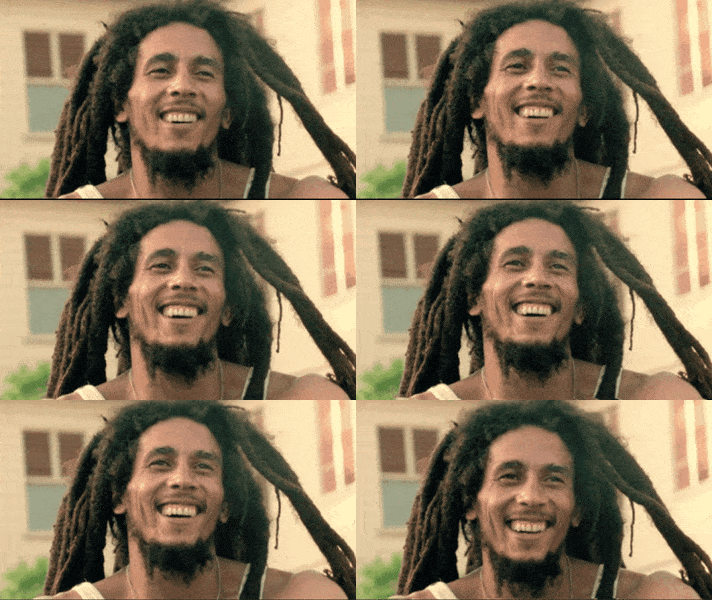
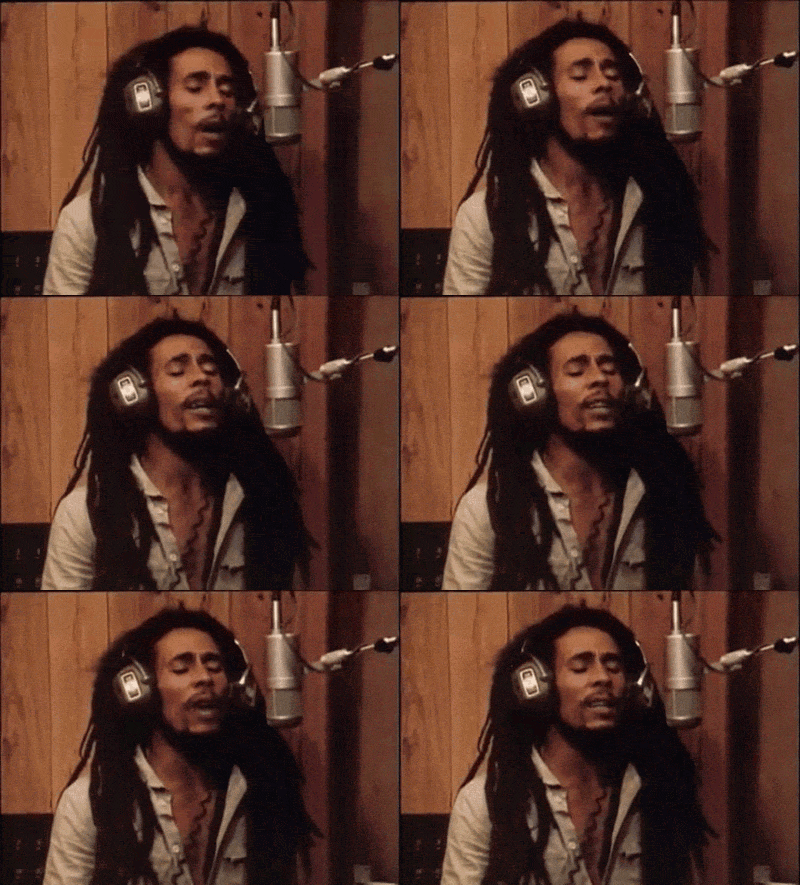
Bob Marley

Bob Marley (1945–1981)

Bob Marley is the greatest Reggae figure. With his band, The Wailers, he made Reggae a worldwide music style. Songs like "No Woman, No Cry," "Three Little Birds," and "Redemption Song" are famous for their spiritual and political depth. He is the global symbol of Jamaican culture and Rastafari.
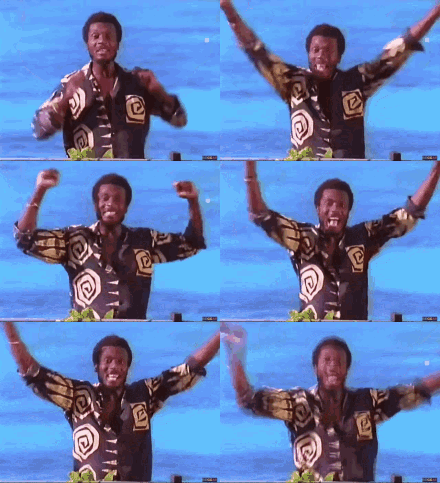
Jimmy Cliff

Jimmy Cliff

An early star of Reggae who found fame with the movie *The Harder They Come* (1972). His music is often more soulful and wide-ranging than pure Reggae, blending pop and rock elements. Key songs include "Many Rivers to Cross" and "I Can See Clearly Now."

Bob Marley & The Wailers - No Woman, No Cry (Live At The Rainbow 4th June 1977)

Written by Mario Samuel Budiono | Echoes Of Eras | November 2025

Comments

Post a Comment

Popular posts from this blog

The 'New Jeans' Revolution

The 'New Jeans' Revolution - How Five Girls Changed the K-Pop Game The Surprise Attack That Changed K-Pop In the world of K-Pop, a debut is a massive, months-long event. Companies release teaser photos, concept trailers, and member introductions. But on July 22, 2022, NewJeans did the unthinkable: they just dropped a music video. There were no teasers, no press releases, just a song titled "Attention." This move was the first sign that NewJeans wasn't just another girl group. They were a statement. Managed by ADOR, a new label under HYBE led by the legendary creative director Min Hee-jin, NewJeans arrived with a mission: to become the "new jeans" of the industry—a timeless staple you can listen to every day. What Makes NewJeans So Different? The group's uniqueness isn't just one thing, but a perfect mix of conc...

Clash of the Titans: The Complete Story & Lyrical Breakdown of the Drake vs. Kendrick Lamar Saga

When a Cold War Turned Hot: A Hip-Hop Beef for the Ages When a Cold War Turned Hot: A Hip-Hop Beef for the Ages For over a decade, they were two kings ruling separate kingdoms. Drake , the undisputed king of charts, streaming, and global pop stardom. Kendrick Lamar , the lyrical king, the critical darling, and the Pulitzer Prize-winning voice of a generation. They collaborated, they competed, but mostly, they co-existed in a tense "cold war." In 2024, that cold war finally exploded into an all-out lyrical battle that shook the foundations of hip-hop. The Background: From Collaborators to a Cold War (2011-2023) It wasn't always this way. In the early 2010s, Drake was instrumental in giving Kendrick one of his first major looks, featuring him on the song "Buried Alive Interlude" from his album Take Care . They later collaborated again on Kendrick's hit ...

The Songs They Tried to Silence: Legendary Musicians Who Were Censored

     When a melody becomes a mirror, powers anxious to stay comfortable reach for the volume knob. From protest anthems that rattled governments to sensual ballads that scandalized radio waves, censorship in music is less about decibel control and more about who gets to tell the story. Imagine standing in a crowded square and hearing a voice that refuses to lie. That voice can be a singer in Lagos blasting through an open window, or a folk guitarist in Santiago strumming a chorus for workers, or a punk band in London sneering at the coronation spectacle. As someone who believes art maps truth, censorship is the moment the map gets redacted. Studying these redactions shows us what regimes fear, what cultures refuse to face, and how music often becomes the language of resistance. Below are six emblematic stories each a small history and a cautionary tale. Sources are linked after each section so you can dive deeper. Fela Kuti - Afrobeat, state violence, and an outlawed voi...